Vicki Wilkerson, a Southern author, gives her unique (and sometimes humorous) perspective on the South, her love of writing, and her faith.
Tuesday, January 13, 2026
ILLUMINATED: A Heaven and Earth Novel by Vicki Wilkerson
Friday, December 5, 2025
Jesus Is a Rock
Jesus Is a Rock
When we
read the Bible, we sometimes miss the soft messages and symbolism found in its
passages; consequentially, we may miss lessons that will enlighten us. While I
was writing ILLUMINATED, I stumbled upon a powerful symbol in the Bible that I
used as a motif in the novel. God and Jesus are referred to as rocks in hundreds
of verses, and the Bible uses many synonyms to differentiate how we should understand
our Heavenly Father and His Son as the rocks they are in our lives.
Why a
Rock? A rock or a stone connotes a firm foundation, immovability, safety and
steadfastness. A rock is unchangeable and can be a defense position. It is
eternal—no matter the changing circumstances in one’s life. It is no wonder
that our Biblical forefathers used rocks and stones as metaphors and similes.
Figurative language can be shorthand for concepts that need contemplation. I
took advantage of that same figurative language to add depth to ILLUMINATED.
The
concept starts in Deuteronomy when Moses calls God “the Rock that begat thee”
and “the Rock of Salvation” (Deuteronomy 32:4, 15, 18). Well, those phrases say
all the important things about Christianity. God the Rock is at the beginning
of our lives, and He is the Rock that saves us for all eternity. There is a lot
of need for God as a Rock throughout our lives, as well. The Bible also says,
“The lord is my Rock and my fortress” (Psalm 18:2), and that shows the nature
of God as our place to seek shelter when life becomes difficult.
Peter
calls Jesus the “living Stone” that is rejected, yet chosen (1 Peter 2:4-8).
Even Jesus uses the symbolism when he calls Himself the Cornerstone—“the stone
that the builders rejected” that eventually became the most important stone
(Matthew 21:42, Mark 12:10-11).
One could
do an entire Bible study on the words and phrases that refer to God and Jesus
as rocks and stones:
·
“The
Lord is my Rock”
· “The tested Stone”
"My
mighty Rock”
·
“The
Rock of my strength”
·
“The
Rock of Israel”
·
“The
Stone of Stumbling”
·
“My
God is my Rock”
·
“The
Rock eternal”
·
“The
Everlasting Rock”
·
“Our
Rock of Salvation”
·
“The
Rock of Offence”
·
“The
Living Stone”
The list
of words and phrases for God our Rock goes on, and I have used many in the
novel, but I have two favorite words that I used over and over. Tsur is the
name for “The Lord is my Rock” in the Bible. In the novel, I have used the
imagery of Tsur as the mountain where God resides—where everyone desires to be
because there is celebration and worship on that Eternal Rock. Yahweh Tsuri
(Tsur) is the Hebrew name that refers to God as the ultimate source of power
and salvation.
Another of
my favorite names for God the Rock is Sela’—the Hebrew name for “The cleft of
the Rock” (II Samuel 22:2). I thought deeply upon this name for God. A cleft in
a large rock can be used for shelter and protection when one experiences fear.
I have taken refuge in Sela’ many times during my life. I have hidden in the
protection of the cleft of the Rock when I didn’t know where to turn. The
little baby lights in ILLUMINATED seek refuge and protection in Sela’ when they
are feeling vulnerable.
As you
return to God’s word for enlightenment and guidance, I challenge you to absorb
how the scriptures highlight God and Jesus as Rocks of our Salvation and the
eternal sources of unwavering strength to survive the storms of this life.
Wednesday, February 9, 2022
MY YEAR WITHOUT FACEBOOK
When Facebook first started, I was excited to sign up and use the social media platform. I was able to touch base with friends I hadn’t seen in a very long time. It was new and fun. I remember one of my posts at the beginning was something about Facebook reminding me of kindergarten. People were kind to one another, clicking smiley faces on cute posts and giving a thumbs-up to everyone’s comments.
Facebook, over the years, however, turned into something
very different from its beginnings. It became a place where bullies would say
the most horrendous things to people they called “friends” and to people they
didn’t even know. I was abhorred and mortified to see such behavior. People had
started using it to ghost others and stalk acquaintances. Facebook had become a
battleground for intolerance and divisiveness.
And that is one of the many reasons why I furtively left
Facebook for over a year. And you know what? I didn’t miss the medium One. Little.
Bit. I did, however, miss some of my good friends and their positive, uplifting
and inspiring posts.
During the past year, I have had to care for some of the
most special people in my life in a way that they had never needed before…and I
was honored to do that…and I still am. In the little time I had left over, I
learned some very valuable things during my year without Facebook.
I learned that a sense of peace had settled over me during
my year of absence from the social media giant. Life was calmer, more serene. I
was present—truly present—in everything I did. No more taking the time to write
blurbs and post photos of my making wine, baking bread, having dinner with my
precious husband, and camping with great friends. I did all those things, and I
took some photos for my personal scrapbook, but I lost the desire to promote
and gained the extra time it took to do it...and peace of mind in not having to
monitor my account to respond to the people who took their precious time to
make comments. And you know what? Most people didn’t even care that I didn’t
post (we take our curated online selves too seriously sometimes)!
After a while, I began to think of my dear friend, Henry
David Thoreau, who said in Walden, “I
wanted to live deep and suck out all the marrow of life.” If life were the marrow,
I discovered, Facebook was the fat. That “fat” had been, at times, unpalatable
and always unnecessary, it seems.
My absence was a year that I grew closer to my husband and
family. I stayed in touch with many friends though phone calls, visits, texts,
lunches and camping trips. I somehow managed to still find out about important
events in the lives of friends and extended family—just like before Facebook
ever became Zuckerberg’s entrepreneurial, maniacal, money-making monstrosity
that it has become in so many people’s lives. I didn’t miss Mark and his greedy
friends spying on my purchases and searches, only to shamelessly promote their
advertising sponsors and cagy agendas. I got my information and news from
independent sources, just like in the old days.
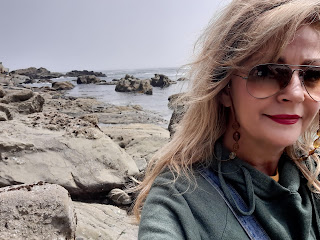
| Last summer we spent time on the Oregon coast. |
As in so many cases, however, all good things must come to
an end, and my time away from the social media behemoth has, as well. Authors—it
seems—need social media (to some degree) in today’s world. I have settled back
in to editing a couple of novels that I had finished last year, so I suppose I
need to inform my readers about releases and such. This time around, though, I
will manage Facebook with boundaries (my new best friend) and on a calculated, scaled-back
basis. I will operate with the knowledge that too much of a good thing is
surely to become a bad thing, so I will release the unnecessary and will keep
all the positive portions of what I have learned during My Year without Facebook.
So, who cares about My Year without Facebook? Perhaps,
nobody will, or perhaps what I’ve learned may be beneficial to someone. If it
is something that intrigues you, you might consider altering your presence on Facebook,
as well. Either way, I wish you well…and peace.
Thursday, December 3, 2020
Relationships Are Bridges
Relationships are bridges. They are two-way passages that make easy the travel over difficult terrain. They are necessary, essential, and in nearly every case, they are the central device that connects people.
I love metaphors because they address
multiple learning modalities. They not only target auditory learners, but they
also create mental pictures in people’s minds, thereby, targeting visual
learners, as well. Therefore, the metaphorical information will more likely be
remembered and valued.
So, to demonstrate my metaphor that
relationships are bridges, allow me to elaborate. Relationship bridges are not like
large public bridges, supported by state and federal taxpayer funds. Instead,
they are privately-owned, small bridges, supported and maintained by two people—the
two people in the relationship.
Imagine if only one of the two people
is tending the bridge, caring for it, maintaining it, painting it, replacing
boards and rails, travelling over the bridge, making it relevant, and the other
person completely neglects the bridge, never making an attempt to cross it, to
spend time on it, maintaining it—essentially not valuing it and ignoring it
until the bridge lover makes another attempt at keeping the little bridge that
connects the relationship viable. And in some cases, the bridge snubber, even subversively sabotages the delicate bridge, defaming it, throwing little cherry bombs at the bridge or even setting
small fires because she has no investment in the little bridge. Eventually, the
bridge will be used less and less because the bridge lover will grow tired and
weary, unable to convince herself that any of her hard work is appreciated.
So, my friend, I encourage you to
tend your bridges. They are too precious to lose and too expensive and
difficult to rebuild.
Thursday, July 16, 2020
Symbolism Is in the Eye of the Beholder
Just like beauty is in the eye of the beholder, so follows symbolism. Symbolism adds depth and meaning to works of literature. It causes people to engage in the process of reading, to infer, to contemplate.
I work hard to build symbolism into each novel I write and into each poem I pen.
Most students
would offer the following words: the fifty states; freedom; America; life liberty
and the pursuit of happiness; patriotism; liberty; independence; opportunity,
etc. You get the picture. I would then tell them that if this flag were placed in
another country, and I asked the same question, I would hear very different
responses. Some may say the American flag might symbolize tyranny, injustice,
imperialism, death, torture, the CIA, bullying, lies, warmongering, etc.
Critical
thinking is a highly-valued commodity on Bloom’s Taxonomy of Higher-Order
Thinking Skills. As a teacher, I tried desperately to encourage and support analysis and evaluation in my classroom. If a student could defend her interpretation of
symbolism, even if I disagreed, I rewarded her inferences. I applied those same
skills as a graduate student to infer meaning and symbolism in obscure pieces
of literature that were not found in literary criticism. Now, the media,
political groups, cultural groups and politicians are telling me that I am not
free to infer symbolism on my own (for certain things), but I know that when
that freedom is breached, there will be no end to the power to control thoughts
and freedoms. Those entities prefer that others operate at the bottom of Bloom’s
Taxonomy for Higher-Order Thinking Skills. Their demand is for the masses to
simply “remember” and “understand,” to simply regurgitate what they wish the
public to think.Tuesday, February 18, 2020
Eyes in the Back of My Head
If you ask twenty different authors about from where his greatest strength as a writer comes, you may get twenty different answers. And most, if not all answers, would probably come from a place that you’d least expect.
I can, for example, tell you that you may be surprised to learn mine. At first, if you looked at my curriculum vitae, you might guess that my gift may have come from my education. I have a bachelor’s degree in English and a master’s degree in English education. I even have a year’s work on a PhD. During my courses of study, I took many classes in literature, writing, poetry, linguistics, and the list goes on from there. I did learn many useful things in those classes that continue to help me write today, but you’d be incorrect to believe that my education was my greatest strength.
My training as a writer continued when I sought out writing organizations and groups. I spent many years going to conferences, seminars and workshops, and I bought and poured over many books on the craft of writing. I met a number of award-winning authors and became friends with some. Their rises to the New York Times Bestsellers Lists and the USA Today Bestsellers Lists were impressive, and they shared their tips and secrets about their climbs with me. I sat in a number of critique groups with them and learned from them…but even all that would not be where my greatest strength as a writer lies.
Well, you might question, did it come from my employment as a managing editor at a publishing house? Even though I poured over many hundreds of manuscripts and ushered many through the publication process—from submission, to acquisition, through a three-pass editing process, to copy-editing, to proofreading, through creating back cover blurbs and managing the cover process and ultimately the book’s publication and marketing—you would be wrong if you guessed that my position as managing editor informed my writing the most.
Ah, you say, is it that my strength comes from my love of literature and, therefore, my love of reading? Nope. Though I love literature—especially Southern literature—and I can be a voracious reader at times—that is not from where my greatest strength comes. Maybe you would go back a little further to when my grandfather ignited my love of story when he told me countless tales on his front porch as a little girl…or maybe it began when I started writing poetry and stories when I was in elementary school because of my grandfather’s tales. Nope and nope.
My greatest strength comes from my having been a teacher. I not only learned how to captivate an audience, but I learned how to effectively convey information through inspiration. It was in that profession that I learned about people, and I applied that knowledge to writing characters.
You see, when you are a teacher, you develop eyes in the back of your head. I didn’t understand this concept at first. When I was student teaching, I didn’t have that talent. But I recognized it the first time I saw it in a colleague when I was paired with him to do “Lunch Duty.” Ken Boleman was a consummate professional. We stood together for a week in the outdoors of Summerville Intermediate High School at our station. As we talked, and he showed me the ropes, he interrupted our conversations again and again by strolling over to different groups of students. I was confused each time he left, but he had seen something that I had not. He would come back with confiscated cigarettes or other contraband. He stopped multiple instances of PDA (and more). I was amazed at his intuitive assessment of each situation—situations about which I was ignorant. I realized then that he had those mysterious “eyes in the back of his head.” He had honed his ability to read situations, behaviors and people. I wanted that skill!
It took a couple of years, but eventually I grew the same eyes in the back of my head. After watching thousands upon thousands of students try the same types of tricks, teachers learn the subtleties of behaviors. I learned to watch for the “watching of the teacher” and then the averted eyes. I learned about both sincere excuses and apologies…and the insincere ones. I learned character…and character traits. I watched as students wanted to learn from me…and I watched those who tried to play me.
I saw the characteristics in students that propelled them to go on to be doctors and lawyers and ministers and teachers, and I saw the characteristics in some students that turned them into murders, rapists, thieves and pedophiles.
Throughout my years, as I was developing my eyes in the back of my head, I still stayed positive, looking for goodness. I always hoped for the best in each student and gave each a chance. Though we weren’t allowed to openly express our religious beliefs to our students, I always lived my Christian beliefs in front of them, extending the hand of kindness and understanding, even through their issues. Many of my greatest rewards were with those students.
Being a teacher taught me how to understand one of the most important trinity concepts in writing—goal, motivation and conflict. I saw how these concepts were worked out in my students’ lives. I learned to read subtle signs of need, greatness, disrespect, compassion and corruption… I learned…people, and I responded with empathy.
From those years as a teacher that I spent understanding people, I understood what goes into characterization. I learned to write the subtleties of three-dimensional characters—their needs, their issues and how those things manifested themselves in characters’ daily lives, and how to resolve those conflicts on the page.
So, ultimately, though you may not have guessed at first, my greatest strength as a writer comes from my teaching experiences, where I grew the eyes in the back of my head.
Friday, February 7, 2020
Shakespeare Is Southern!
Will has created words and phrases that have gone mainstream in the Southern dialect. He gave us, “Neither here nor there" for us to dismiss extraneous comments. He gave us “Salad days” to help us remember our youthful, more inexperienced times. He gave us “Send him packing” to colorfully show how we get rid of carpetbaggers and other useless people.
Will told us that “Mum’s the word” so that we can pretend we don’t gossip about our neighbors, and he taught us how to live “With bated breath” when we anxiously wait for Northerner neighbors to understand our Southern way of life, which may never come.
Particularly in the South, I have seen the “Green-eyed monster” rear its ugly head when one family thinks its heritage is grander than another’s. I have seen people’s hopes “Vanish into thin air” as their dreams don’t materialize. And in almost every tale told in the South, I have heard said tale turn with the phrase “All of a sudden.”
Personally, I have been on a “Wild goose chase,” trying to find a decent man to date, and I’ve been “Eaten out of house and home” by hungry party guests. I’ve been “Up in arms” over people who do not know how to appreciate my Southern hospitality, and I’ve have seen “The devil incarnate” in the form of fake friends. I’ve been told that someone has “A heart of gold” at my church, and I’ve been told that “All that glitters is not gold” by my mother. I’ve also been told that many times something that I would like to affect a change has already been declared a “Forgone conclusion.”
I could go on and on, but you’d eventually tell me “Good riddance,” so I’ll move on so I don’t get myself in “A pickle.”
William’s plays and poems hit at the very heart of the human condition, and that fact is the very detail that makes Will so Southern. Romeo and Juliet features families that feud over social status (such a Southern theme). Julius Ceasar shows how even the common man cannot handle power, and how war is always at hand. Hamlet teaches us how crazy and underhanded even honorable families can become. Macbeth is the epitome of envy and social climbing. Hello, these themes (and more) are at the core of Southern society.
Southerners have adopted so much of what William Shakespeare wrote in the 1600’s, even though all may not even understand from where it came. Though you may say “It’s Greek to me,” I will continue to advance the theory that Shakespeare is essentially Southern all the “livelong day.”
*All phrases in quotations are from the bard!


